
The Science Behind TOVAx
TOVA is working to develop a vaccine that could prevent river blindness by stopping the parasite Onchocerca volvulus before it can establish infection. Our approach targets the parasite’s early larval stage, with the goal of preventing it from developing into adult worms that cause disease and sustain transmission. The studies below describe the scientific foundation of this work, including the selection of vaccine antigens, testing in animal models, and the immune responses that may help provide protection. Together, they show how the program has moved from concept to a defined lead vaccine strategy.
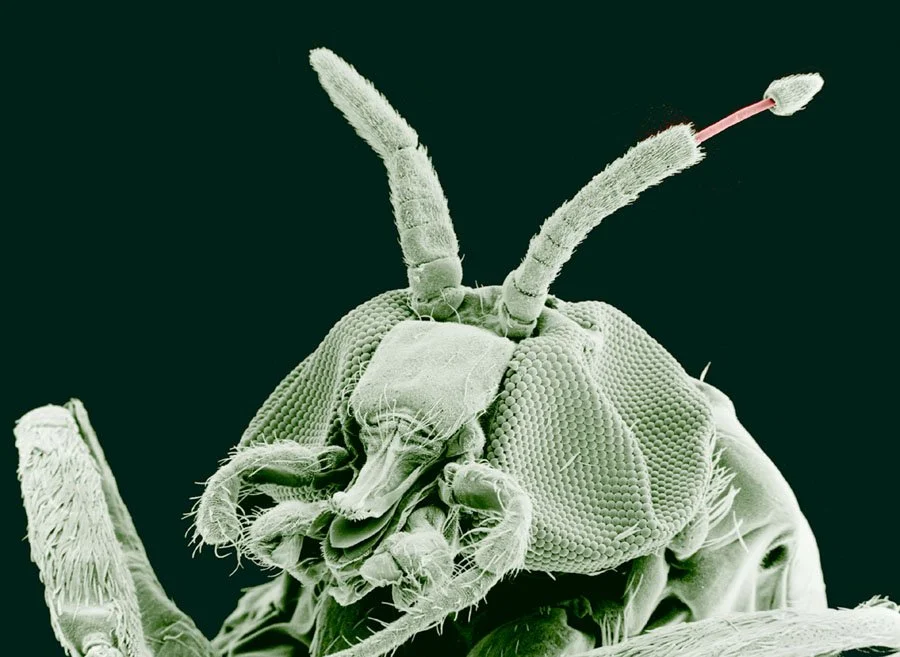
Adult Black Fly with the Onchocerca volvulus worm emerging from the insect's antenna.
(United States Department of Agriculture, Public Domain, via Wikimedia Commons)
Explore the publications below to see how TOVA’s vaccine strategy has evolved—from target discovery to proof-of-concept and mechanism of protection.
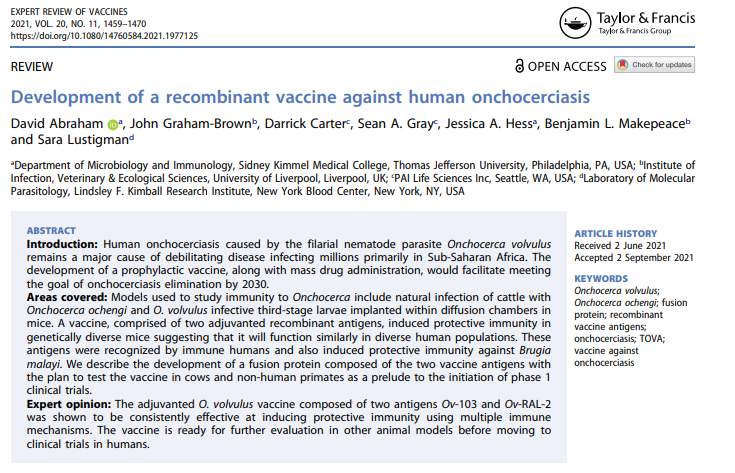
How the TOVA vaccine strategy works
TOVA’s vaccine program is designed to stop Onchocerca volvulus early—at the infective third-stage larval (L3) stage—before the parasite can mature, reproduce, and drive disease and transmission. Across these studies, the team has moved from identifying promising antigens to testing a lead fusion vaccine, showing protection in multiple animal models, and explaining how that protection works.
Vaccine Candidate
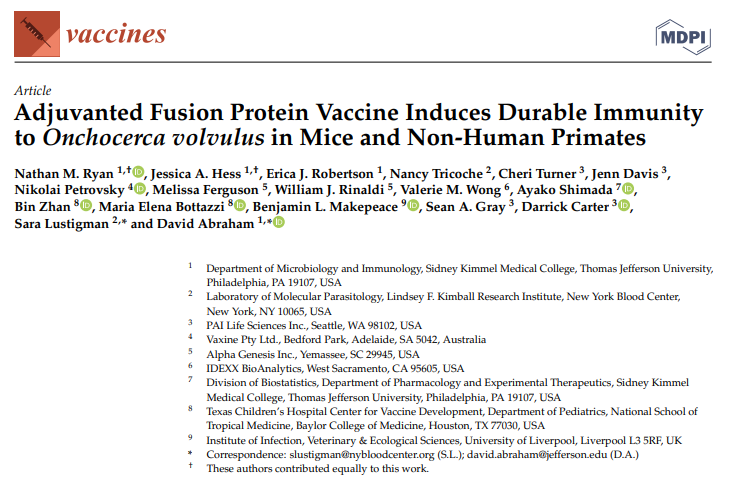
This paper introduces Ov-FUS-1, the lead vaccine candidate, which combines two promising parasite antigens (Ov-103 and Ov-RAL-2) into a single fusion protein. In mice and non-human primates, the vaccine produced strong antibody responses, and when paired with an immune-stimulating adjuvant, it generated protection in mice that remained durable for at least 11 weeks. The study also showed that serum from vaccinated animals could transfer protection to unvaccinated mice, a strong sign that vaccine-induced antibodies are doing the important work.
Animal Studies
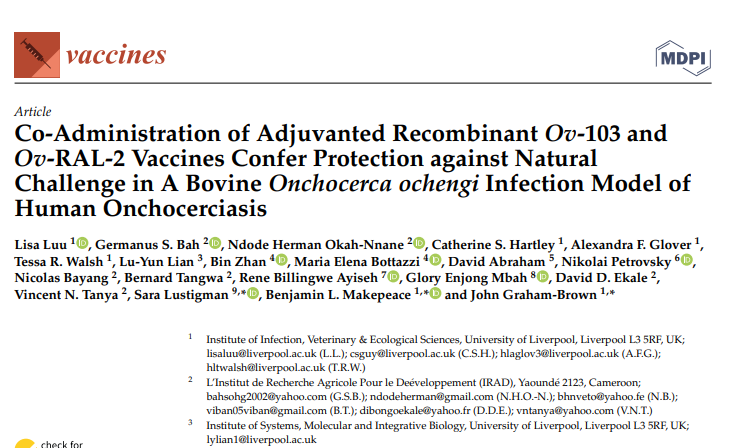
This study tested the vaccine approach in cattle naturally exposed to Onchocerca ochengi, the closest animal model to human river blindness. Over a 24-month exposure period, vaccinated animals developed infection and skin microfilariae at lower rates than unvaccinated controls. That matters because it shows the vaccine can reduce infection pressure in a real-world challenge model, not just in short laboratory experiments.
Mechanism
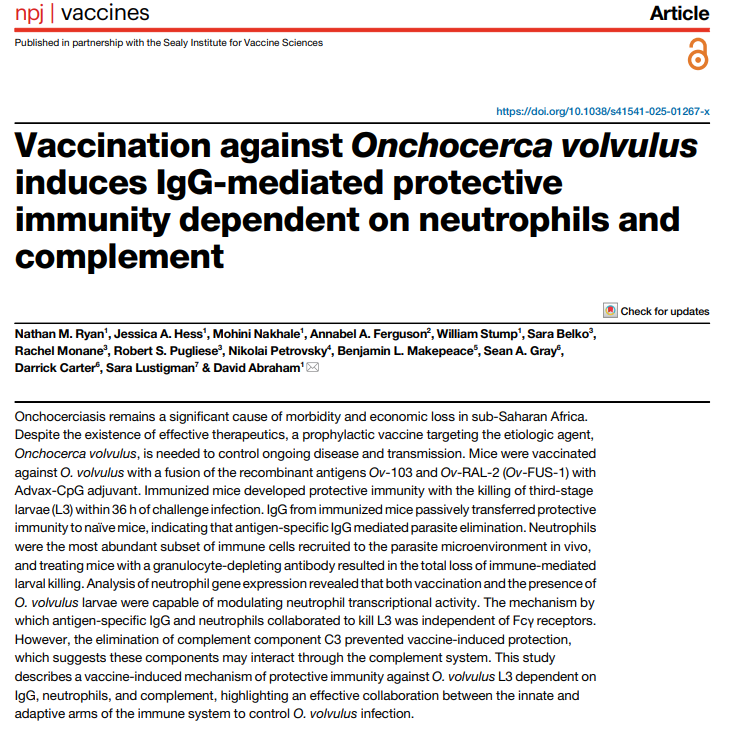
This paper explains how the vaccine appears to work. It found that antibodies generated by vaccination can transfer protection, that neutrophils are essential partner cells in killing the parasite larvae, and that complement component C3 is also required. The study showed that larval killing happens quickly—between about 18 and 36 hours after challenge—highlighting a coordinated immune response that blocks infection at a very early stage.